
238 Units Gone. 106 Will Take Their Place. — A Miami Story
Miami Beach · Real Estate · Opinion
The demolition of Bay Garden Manor is being celebrated as a triumph of luxury development. Somebody should also talk about what we’re burying under the concrete.

I scroll past a lot of real estate content on Instagram. It’s unavoidable when you live in South Florida and follow anyone even tangentially connected to the industry. Flashy renderings. Drone shots of half-finished towers. Realtors in front of skylines telling you now is always the time to buy. I’ve learned to swipe past most of it without a second thought.
But a reel posted recently by @krengroup, in collaboration with @pedrocasanovarealtor, stopped my thumb cold. The footage was simple — excavators tearing through what used to be a 15-story residential building on West Avenue in Miami Beach, rubble where apartments used to be, and a caption that read: 238 old units demolished for just 106 luxury condos.
I watched it three times. Then I started digging.
What actually happened here
The building was Bay Garden Manor, at 1250 West Avenue — a 15-story condominium built in 1964 on a 1.9-acre bayfront lot in South Beach. For six decades, it was home to 238 units: modest by today’s standards, occupied by a mix of long-term residents and investors, sitting on some of the most valuable waterfront land in the state of Florida.
Starting around 2021, a development partnership led by Michael Stern’s JDS Development Group — joined eventually by David Martin’s Terra Group, Gianluca Vacchi’s GV Development, and RG Development — began quietly buying up units. One by one. Then in batches. The buyout took years, required negotiating with over 100 individual owners, and ultimately cost the group roughly $120 million to assemble the full site, including the neighboring Bikini Hostel at 1247 West Avenue.
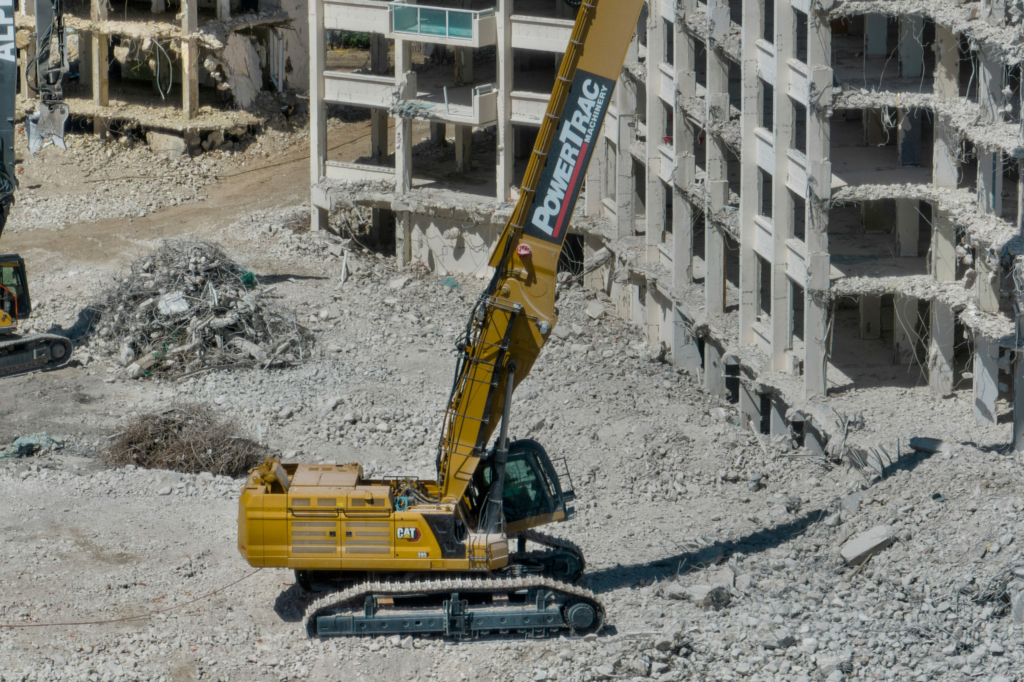
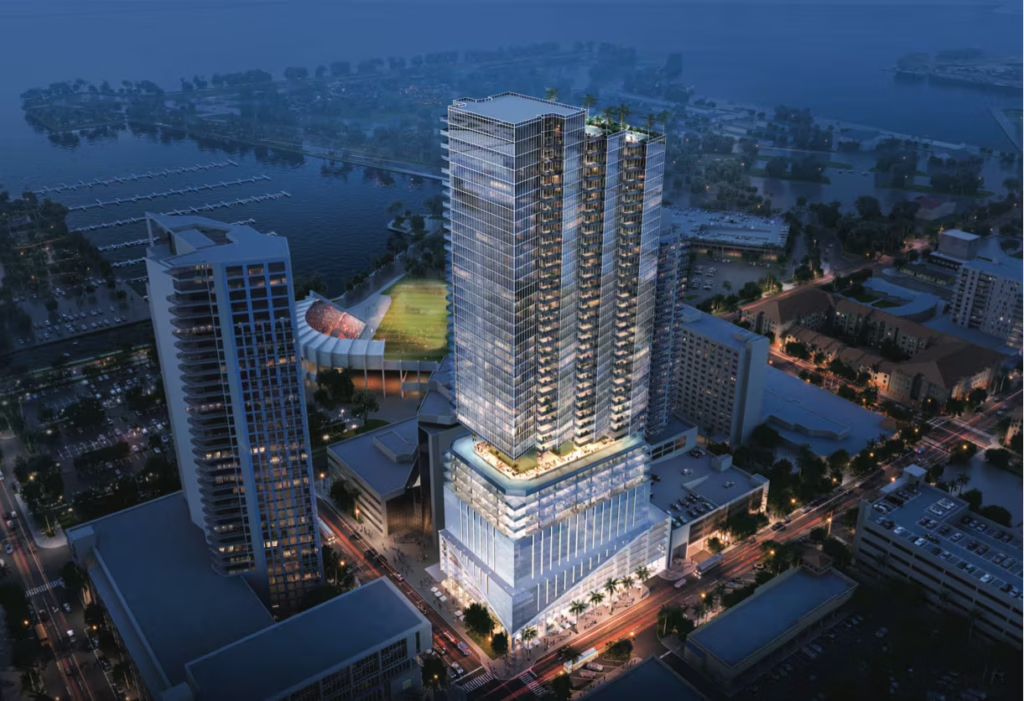
By September 2025, they’d acquired more than 95% of the building. The condo association was dissolved — a legal prerequisite for demolition — and residents were given roughly six months to vacate. The excavators showed up not long after. What you see in that Instagram reel is the result: 238 homes reduced to rubble, clearing the way for a 28-story, 363-foot tower designed by ODP Architects in collaboration with MK27 Architecture, carrying 106 residences averaging roughly 3,479 square feet each.
To put that in plain terms: the average future unit will be about the size of four of the units that used to exist there.
“The math is not subtle. You are removing housing for 238 households and replacing it with housing for 106. In a city with a housing affordability crisis, that arithmetic is not a footnote. It is the story.”
The deal that made it happen
What I find genuinely impressive — from a pure real estate structuring standpoint, and I say this without sarcasm — is how technically complex this transaction was. Condo buyouts of this scale are described by attorneys who work in this space as exceedingly rare. You’re not negotiating with one seller. You’re negotiating with over a hundred individual owners, each with their own attorney, their own emotional attachment to the property, their own financial situation and timeline. Dan Marinberg, the attorney and broker who brokered the Bay Garden Manor deal, said he’s currently working with six other South Florida condo buildings considering similar bulk sales. The playbook, once proven, spreads fast.
The financing was equally interesting. Northwind Group originated a $98 million senior secured loan for the acquisition phase alone. The logic was spelled out plainly in the deal announcement: premier development sites in South Beach are essentially gone. The only way to build new luxury product on the water is to buy the land that’s already been built on — which means buying out the people who live there.
Miami Beach commissioners approved the tower’s height at 330 feet, more than double the previous zoning limit. In exchange, the developers agreed to reduce density from a maximum of 286 units to 106 — fewer, larger, more exclusive homes — and to fund new segments of the public Baywalk, as well as demolish the Bikini Hostel and replace it with a park. The city called this a public benefits package. Critics called it something else.
The part that keeps me up at night
Here is where I need to step outside the deal memo and say something plainly, because I don’t think enough people in the circles I run in are saying it.
Bay Garden Manor was not luxury housing. It was built in 1964. Units were reportedly selling for somewhere between $215,000 and $310,000 when JDS first started buying in 2024 — which, in the context of Miami Beach, is as close to affordable as this island gets. These were not cheap apartments. But they were attainable in a way that a $3,000-per-square-foot luxury residence never will be. The people who owned or rented there were not the ultra-wealthy. They were, by Miami Beach standards, the middle.
And they are now gone. Not relocated to comparable housing in the same neighborhood — there is no comparable housing in the same neighborhood, because this process of luxury replacement has been systematically eliminating it for two decades. Gone to wherever people go when the place they called home gets bought out from under them by a $120 million development partnership backed by institutional capital.
I’m not naive about how real estate development works. I understand that aging buildings in South Florida face a brutal financial reality — especially after Surfside. The 2021 collapse of Champlain Towers South changed everything about how older condo buildings are assessed, maintained, and valued. Rising insurance premiums, deferred maintenance bills, and mandatory structural recertification costs have made ownership in older buildings increasingly untenable for people on fixed incomes or modest budgets. The developers who approached Bay Garden Manor residents weren’t wrong to point out that staying was becoming expensive. But that context doesn’t make the outcome less stark. It makes it more complicated — and more painful.
Jorge Betancourt, who was president of Bay Garden Manor’s condo association, said that selling was “unsolicited for a lot of people.” That sentence has stayed with me. These weren’t residents who were looking to cash out. They were residents who were found by capital that wanted their land more than they wanted to live on it.
The Bikini Hostel subplot nobody wants to talk about
And then there is the Bikini Hostel. The developers agreed to acquire it, demolish it, and turn it into a park — part of the public benefits package that got their height variance approved. On the surface, a park sounds generous. Public space on Miami Beach is genuinely valuable and genuinely scarce.
But the Bikini Hostel currently serves portions of Miami Beach’s unhoused population. According to reporting at the time the deal was approved, some residents actually expressed relief that the hostel would be eliminated. Advocates expressed something different — concern about where the people currently sheltering there would go. A park is a beautiful thing. It is not a roof.
I keep thinking about how this deal was packaged and sold to the public: a Baywalk, a park, architectural beauty, community benefits. And all of that is real. The Baywalk will be real. The park will be real. The tower will probably be genuinely stunning — JDS does not build ugly buildings. But the community benefits package is also a way of making a transaction that removes housing look like one that adds it. And those are very different things.
“A park where a shelter used to be is not a community benefit. It is a community trade-off. And the people who paid for it with their displacement are rarely the ones quoted in the press release.”
The broader pattern I see from where I stand
I’ve spent enough time working with brands in South Florida to understand that what’s happening at 1250 West Avenue is not an isolated event. It is a template being replicated with increasing speed across Miami-Dade and Broward. Dan Marinberg told The Real Deal he is working with six other buildings considering bulk sales. Terra CEO David Martin framed the project as “part of a transformation of an area in Miami Beach yearning for a resilient neighborhood.” The Northwind Group’s announcement described South Beach as “nearly completely infill” and said that accessing premier waterfront land now requires buying out and demolishing what’s already there.
This is not sinister language. It is honest language. It is exactly how the market works. But when you say the quiet part out loud — that the only way forward for luxury development on this island is to systematically acquire and erase the existing housing stock — the implications for the people who actually live here at middle-income levels are not ambiguous. They are being priced, bought, and demolished out of existence.
I’ve read the commentary celebrating this project. A lot of it focuses on design — the Kobi Karp architecture, the MK27 collaboration, the 363-foot profile against the bay. Some of it focuses on economic activity — the construction jobs, the tax revenue, the signal that Miami Beach is still a global luxury destination. None of that is false. I’m genuinely curious about what this building will look like when it’s finished.
But I find myself unable to separate the aesthetic conversation from the human one. When Instagram reels show demolition footage and caption it with “238 old units demolished for just 106 luxury condos,” the word “just” is doing a lot of heavy lifting. It implies that the trade-off is merely numerical. That what’s being lost is old and therefore expendable. That what’s replacing it is progress.
I’m not sure progress is the right word for a transaction where the unit count goes down by more than half and the price per square foot likely goes up by a factor of ten.
What I actually think
I want to be fair, because I think fairness matters here and because reflexive outrage without nuance doesn’t serve anyone. The developers made legal offers. The owners accepted them. The city approved the project through its proper process. The Baywalk and the park are real commitments with legal teeth. The building being torn down was old, increasingly expensive to maintain, and sitting on land that Florida’s condo safety laws were making harder and harder to keep viable.
And yet.
There is a version of this city that is accessible to nurses and teachers and restaurant workers and the hundreds of thousands of people who make Miami Beach function day to day. That version gets a little smaller every time a project like this breaks ground. It doesn’t disappear all at once. It erodes — building by building, buyout by buyout, reel by reel — until one day you look up and realize that the only people left on the bay are the ones who could afford to be there from the beginning.
Miami Beach is a place I love. I have watched it transform over my lifetime in ways that are genuinely thrilling and in ways that are quietly devastating. The skyline gets more beautiful. The streets get more expensive. The community — the real, messy, multi-income community that gave this place its character — gets thinner.
238 units. 106 will replace them. The excavators have already done their work.
I just think someone should say out loud that what’s being cleared isn’t just rubble.
– Nestor Andre
Sources: The Real Deal Miami, Commercial Observer, Floridian Development, SoBe West Neighborhood Association, Multi-Housing News, BRG International, Northwind Group press release (September 2025 – March 2026). Originally surfaced via Instagram reel by @krengroup in collaboration with @pedrocasanovarealtor.